
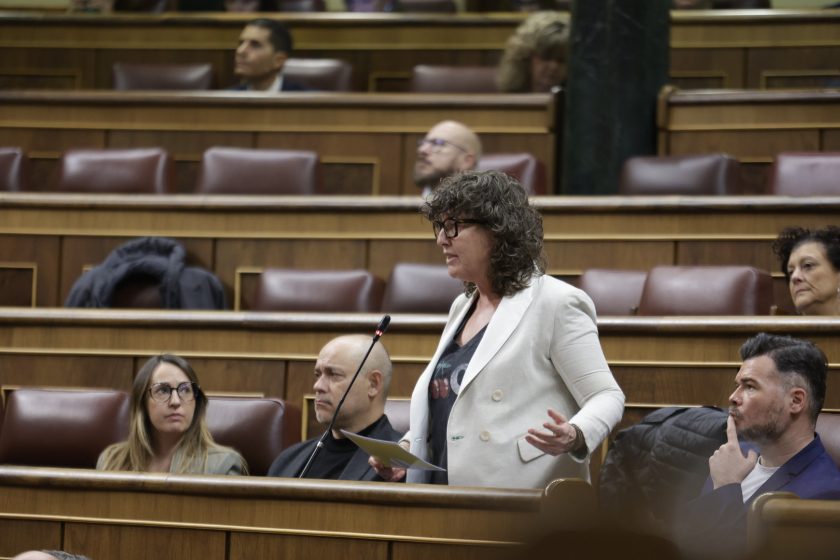
Esquerra confronts the Spanish government with a frontal rejection of the agreement between Europe and South America: “We demand a binding parliamentary debate”
“We want your government to firmly oppose ratification of the agreement in Brussels and to defend jobs in the primary sector, our food sovereignty and the protection of the environment.” That was the bone of contention Congress deputy spokesperson for Esquerra Republicana Teresa Jordà pointedly put to Spain’s Minister of Agriculture, Fisheries and Livestock Luis Planas in the lower house on the trade agreement between the European Union and Mercosur that will seriously harm the Catalan primary sector.
Ms Jordà marked on the negative impact that the entry into force of this agreement can have on the farming community in Catalonia, since according to the congresswoman, it will “liberalize” over 90% of tariffs with some Latin American countries such as Argentina, Brazil, Uruguay and Paraguay, allowing massive imports of agricultural and livestock products that will not be required to comply with the Union’s safety and quality standards.
In his response, the minister countered offering an entirely unsatisfactory response for Esquerra, attempting to provide data to justify his position in favour of the agreement. “It is a great geopolitical and also agri-food opportunity for the Union,” he said. “The government's assessment is very positive,” he added.
In the face of this, Esquerra’s number two in the Spanish Congress did not shy away from replying with “A lot of figures, but in the meantime our primary sector cannot make a living.” Ms Jordà showed her anger at the minister’s position, recalling the situation “at the limit” that the primary sector is experiencing not only in Catalonia but also throughout Europe. “We must defend jobs, food sovereignty and the environment,” she insisted.
Ms Jordà thus called for a “binding parliamentary debate” in the Spanish Congress so that it is the representatives of the people who decide on this trade agreement. “The voice of livestock farmers is essential and the policies that affect them cannot be decided behind their backs,” she concluded.