
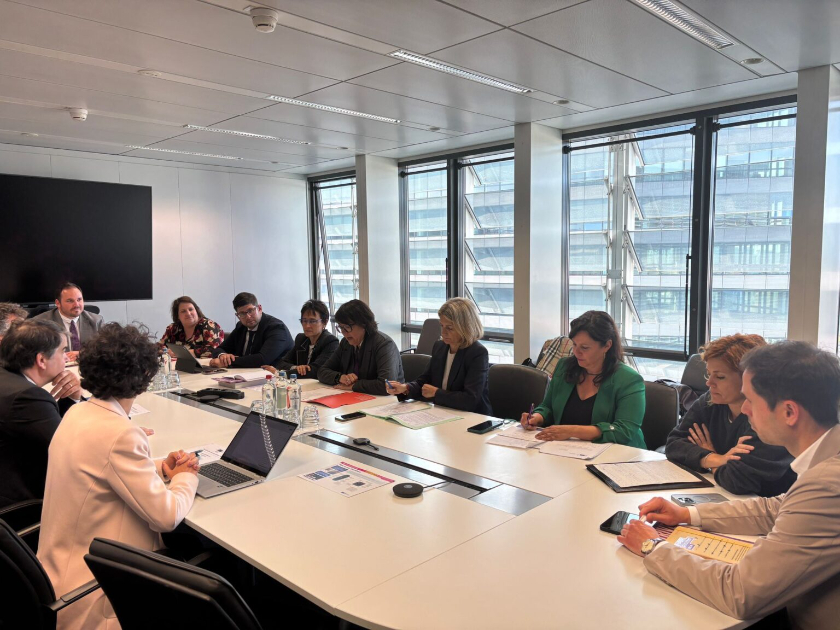
Esquerra’s two leaders deliver over 600 signatures of European elected officials demanding a real and active role for regions and municipalities in the management of European funds.
Esquerra Secretary General and mayoral candidate for the city of Barcelona, Elisenda Alamany, and MEP Diana Riba, President of the European Free Alliance (EFA) parliamentary group in the European Parliament, attended a meeting today in Brussels with Raffaele Fitto, European Commission Executive Vice-President for Cohesion and Reforms.
In this meeting, which was also attended by other EFA leaders, Mr Fitto was presented with over 600 signatures from European local and regional elected officials. The signatures call for the effective participation of European regions and municipalities in the management of European Union resources within the framework of the future Multiannual Financial Framework (MFF).
The meeting forms part of the active negotiations for the forthcoming MFF 2028-2034, and comes a few days after the European Parliament’s Committee on Budgets (BUDG) approved a report that substantially improves on the European Commission’s initial proposal, which was entirely unacceptable for Esquerra. “It is not perfect, but it includes some of the key points for us, as Esquerra and as ALE. This is good news, but we are taking it with caution, because this is only the first step. There is still the vote in the plenary of the European Parliament, and then negotiations with the rest of the European institutions,” Ms Riba pointed out.
In this regard, Ms Riba highlighted three specific improvements in the report passed by the European Parliament committee: assurance of fixed and stable funding for each programme, thus preventing social funds from being diverted to items such as defence; the obligation to establish specific and binding social and climate objectives for each programme; and the restitution of the role of regions and municipalities in the management of European funds. “The Commission’s proposal practically left them out,” she added.
For her part, Ms Alamany focused on two specific demands from local authorities. “Cities cannot be left out of the decision-making processes. If we are not present in the design, implementation and evaluation of European programmes, we run the risk of recentralisation that disengages Europe from its citizens. More Europe means more cities, more regions and more democratic proximity,” she posited. She specifically called for the inclusion of cities in the design, execution and monitoring of European programmes and direct access for cities to European funds, not only in cohesion policy, but also in areas such as housing or social services, where local administrations have direct powers and responsibilities.
Both leaders agreed that the European budget now under negotiation will determine the public policies of towns, cities and nations over seven years, and they warned of the need to maintain pressure throughout the entire process.