
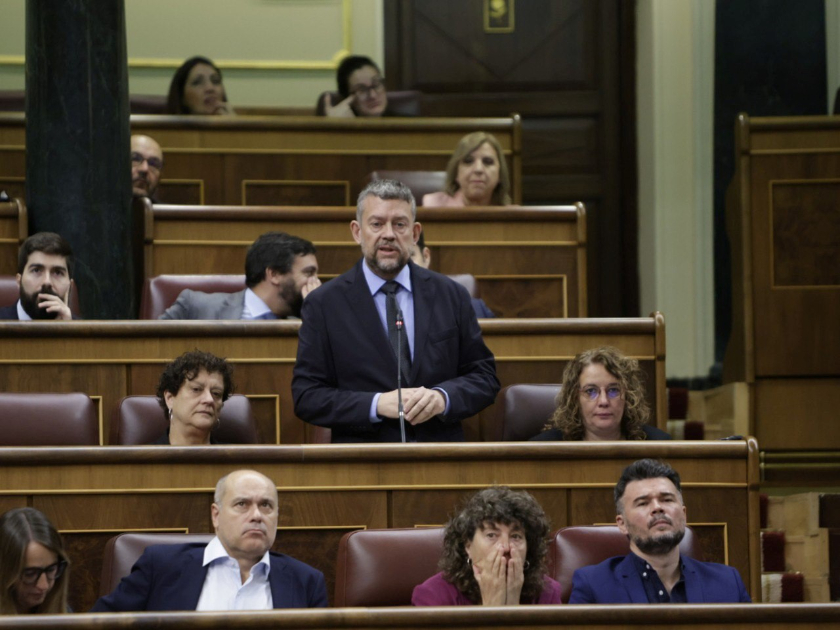
Esquerra’s Group in Congress urges the Spanish government to recognize and give reparations for the documented cases of harassment, abuse and bullying during the 1980s and 90s
The Republican group in the Spanish Congress has introduced a Non-Legislative Motion demanding that the Spanish Government conduct an independent inquiry into the abuses suffered by thousands of conscripts during compulsory military service in Spanish army barracks during the 1980s and 90s.
The complaint comes after the screening of the Catalan TV3 documentary “Et faran un home” (They’ll Make You a Man), which uncovered a praxis of impunity and institutional negligence in the treatment of conscripts, with documented cases of systematic humiliation, abuse and harassment. “Despite the gravity of the exposure, the Spanish Government has responded to Esquerra’s questions assuring that it has no record of the facts and denying any responsibility,” denounced congressman Francesc-Marc Álvaro. “The reply is absolutely inadmissible and we denounce the inaction the institutions have shown for decades. The Ministry of Defence has officially recognized more than 300 cases of suicide between 1983 and 2001 in the armed forces, although the real figures could be much higher,” Mr Álvaro insisted.
The documentary has revealed to several families that the deaths of their offspring, which were officially recorded as accidents but were in fact suicides resulting from the abuse suffered at the barracks. “There is an institutional continuity that goes beyond each government, and this obliges Prime Minister Sánchez’s Executive to hear the demands of those affected and establish such political responsibilities as may befall, and to help establish the penalties, as appropriate.”
Faced with this collective fiasco, Esquerra demands three urgent measures from the Spanish government:
- Open an independent inquiry into the cases documented and guarantee the protection of the victims and witnesses.
- Publicly acknowledge the facts and identify the political and military authorities involved, furthering the necessary legal measures to hold those responsible accountable.
- Establish mechanisms for moral and economic reparation for the victims and their families, including legal assistance and psychological support.
“We are firmly committed to memory, social justice and the defence of human rights, and we demand that these facts do not go unpunished.” “We cannot allow silence and impunity to be perpetuated over a situation that has destroyed the lives of so many,” declared Esquerra’s congressman, Francesc-Marc Álvaro.