
Esquerra warns that the political activism of the high courts of justice jeopardises the separation of powers and collective will
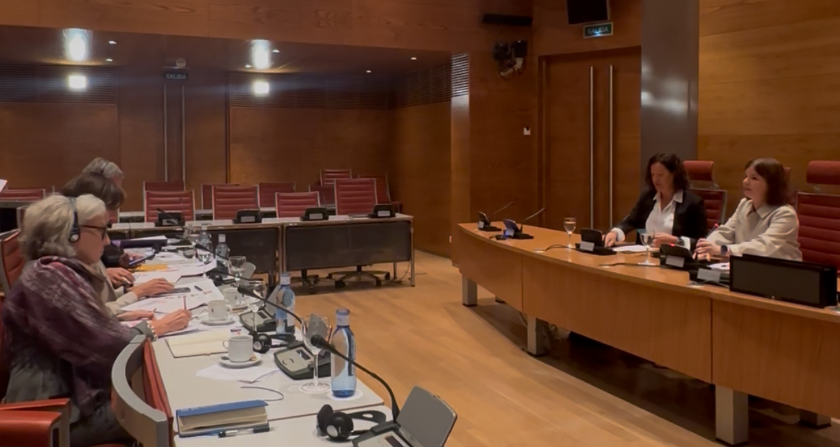
On the occasion of the Venice Commission’s visit to the Justice Committee of the Spanish Congress and Senate on Tuesday to address the system of the election of members of the General Council of the Judiciary (CGPJ), Esquerra Republicana once again warned the Council of Europe’s experts that the Spanish judiciary’s lack of impartiality is why many courts venture to shun the Amnesty Law and other regulations democratically approved by the Spanish parliament.
In this regard, Esquerra recalled that the Spanish judiciary did not make any real democratic transition in the judicial sphere after the end of the Franco regime. The courts changed their names, but the judges from the dictatorship remained in their positions. One example is the Franco regime’s Court of Public Order, which dealt with most political crimes, simply became the current National Court, without any real democratic purge or renewal.
Esquerra’s Senate spokesperson Sara Bailac warned that “This lack of impartiality is what explains why many courts venture to shun the Amnesty Law and other democratically approved regulations.”
Esquerra also noted that the CGPJ does not stay within its strict jurisdiction, but also ventures into political, administrative, disciplinary and promotional functions over the judiciary. It has thus had a prominent role in numerous cases of scandalous appointments without merit or skill, which shows its opaque nature and lack of democratic accountability. These decisions must be answered to before the people’s representatives.
In this light, Esquerra Senator Laura Castel remarked that “Judicial independence cannot be synonymous with impunity. In a democracy, all powers emanate from the people and must be accountable to them”.
Esquerra also denounced that no European or Council of Europe norm in comparative law requires the existence of a body such as the CGPJ, which reinforces the need to review its composition and functions profoundly.
Furthermore, they warned that four out of the five main judge and magistrates’ associations are clearly conservative, which does not reflect the ideological plurality of Spanish society. This anomaly is, among other factors, due to an opposition system that favours certain social and ideological elites.
This all generates a profound ideological bias in the Spanish high judiciary which has in recent years led to blatant political activism, including open acts of rebellion against acts emanating from the legislative branch. This bias calls into question the proper impartiality of the courts responsible for applying the Amnesty Law, and demonstrates a flagrant case of politicisation of justice.
Esquerra Republicana Congresswoman Pilar Vallugera concluded by declaring “What we denounce is not only a historical anomaly but a current, serious problem: the Spanish judiciary has become a political player that blocks the people’s will expressed in Congress and in the Senate, setting itself in clear open rebellion against the legislative branch.”