
The 30th National Congress approves the party's strategic report with 92.3% of the votes
Esquerra Republicana is committed to achieving a “solid and stable” majority in favour of Catalan independence in 2031, and in the meantime, working towards preparing the country, Catalan society and the party, strengthening Catalan institutions and reinforcing national awareness throughout the country. These are the main objectives outlined in Esquerra’s strategic paper, which was approved this Sunday by the plenary of the 30th National Congress.
The “Objective 2031: achieving a social majority in favour of independence” paper states that independence “is the best instrument to guarantee a fairer, more prosperous and more democratic Catalonia.”
The starting point of the paper is the “principle of reality,” and stresses that the loss of the pro-independence majority in the Parliament of Catalonia is not “innocuous” and that it implies a “change of phase” in the politics of the country. Faced with this scenario, the paper posits that in order to continue progressing with “ambitious” objectives, it is necessary to recover the pro-independence majority and the conditions that make the right to self-determination effective. But while this does not occur, it prompts that political resignation must be overcome.
In this regard, the document advocates using the “levers of power” in order to “advance and prepare” the country, Catalan society and the party for when the pro-independence majority has been recovered. And it points to two main objectives.
On the one hand, institutional strengthening requires reinforcement of the Catalan institutions, endowing them with “greater political power, greater sovereignty and greater capacity and influence,” and the reduction of the influence of State institutions in Catalonia. And on the other hand, a boost to nationhood, working for a “cohesive” society and enhancing the feeling of national belonging based on a plural and inclusive Catalan identity and with the Catalan language as one of the great cohesive elements.
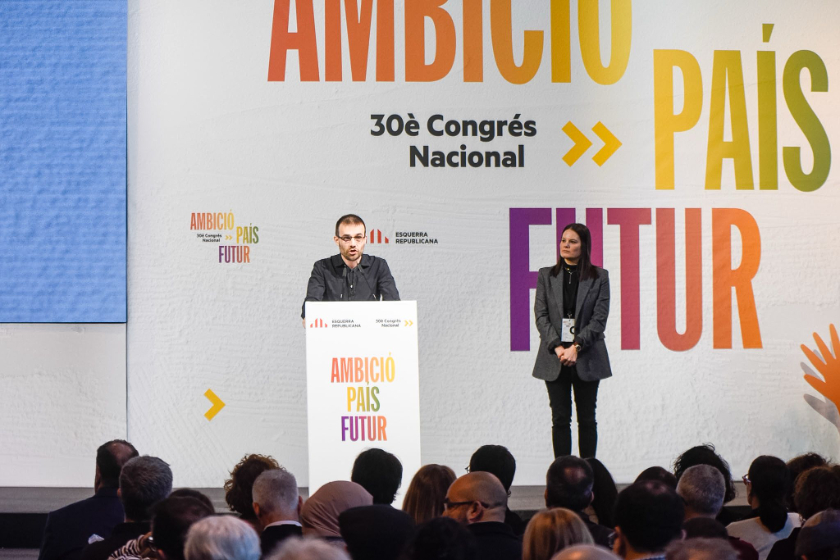
The strategic paper, which was defended at the National Congress by the Deputy Secretary General for Strategy, Joan Plana Sagué, and by the Deputy Secretary General for the Rural World, Solés Carabassa Closa, was passed by 92.3% of the votes (503 votes in favour, 22 blank ballots and 20 against).
The National Congress rejected an amendment that defined Esquerra Republicana as a party “that brings together pro-independence and pro-sovereignty militancies” and advocated a strategy “shared between pro-independence and pro-sovereignty movements” for the construction of the Catalan Republic, as well as “moving forward with the rest of the pro-independence, pro-sovereignty, federalist and progressive political forces on the left.” In a vote in which there were no voting orders from the leadership—the board of the Congress and the members of the National Executive voted differently—it was rejected by 311 votes against, 48 blank ballots and 196 in favour.