
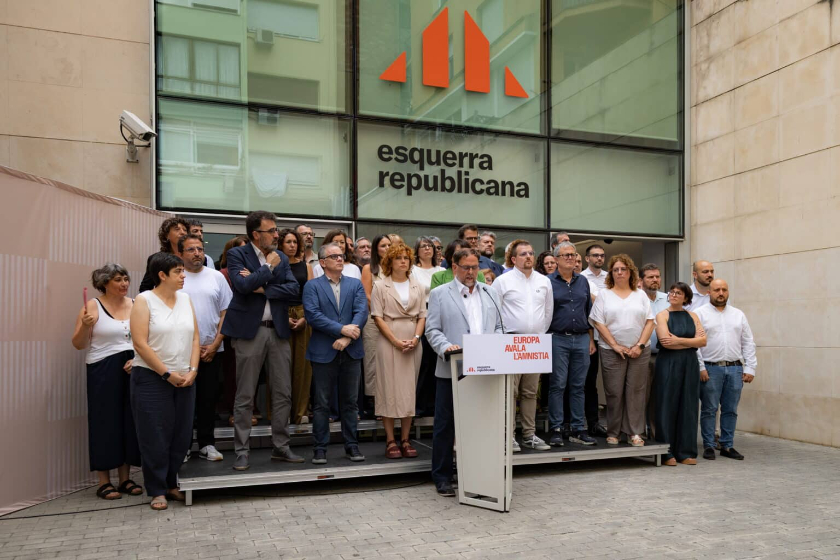
Speech by the president of Esquerra Republicana, Oriol Junqueras, after learning of the ruling by the CJEU endorsing the propriety of the Amnesty Law to European legislation
Today is an important day. Important for Catalonia. And important for the democratic quality of the Spanish State.
It is also an important day for president Carles Puigdemont, for Toni Comín, Lluís Puig, Dolors Bassa, Raül Romeva, Carme Forcadell, Jordi Cuixart, Jordi Sànchez, Jordi Turull, Josep Rull, Joaquim Forn, Carles Mundó, and for so many others who have suffered repression over these long years.
It’s an important day for the 35 people who are directly incriminated in the Court of Auditors’ preliminary ruling C-523/24. We should be amnestied immediately, at least regarding this case.
It’s an important day for the 12 people who were absurdly accused of terrorism, incriminated by the National Court’s preliminary ruling C-666/24. It is an important day for Josep Maria Jové and Lluís Salvadó, also incriminated by the preliminary ruling filed in Luxembourg by the Superior Court of Justice of Catalonia.
Some forty people must be amnestied immediately. A few of us will still have other cases pending.
Today, the Court of Justice of the European Union has spoken.
And Europe has once again put politics back where it should never have been taken from. Today’s ruling validates the essence of a law that was begotten to provide a political response to a political conflict. It confirms what Esquerra Republicana has defended from day one: that repression could never be the response to a democratic conflict.
The Amnesty is a political victory for the independence movement.
That is because it recognizes that what some wanted to turn into a criminal problem was, and continues to be, a political conflict. A conflict about the relationship between Catalonia and the State. A conflict about sovereignty. A conflict about democracy. A conflict that can only find a solution through politics.
It’s been more than two years since the Congress of Deputies passed the Amnesty law. Article 10 of this law is very clear: decisions had to be adopted within a maximum period of two months, and subsequent appeals could not give rise to suspension. Two months. More than twenty-four have passed.
It’s been two years since all those prosecuted, investigated or convicted as a result of the organization of the referendum of the 1st of October should have been amnestied. It’s been two years since our brothers who continue in exile should have come home. It’s been two years since the judicial ordeal of so many should have ended. It’s been two years since some of us should have fully recovered our rights. We should be able to exercise our professions. We
should be able to exercise our politics in absolute freedom and on equal terms. And some of us should probably already have been reinstated under the reform of the Criminal Code in 2022, when the crime of sedition was eliminated and the crime of embezzlement was reviewed.
The Amnesty law has been a great victory.
Around 400 people have been amnestied. Hundreds of people have been able to leave behind unfair judicial proceedings. Hundreds of families have been able to recover a part of their normal lives that they should never have lost.
But today, the Amnesty remains an incomplete victory.
Because a law is not just appraised on the day it is passed. A law is appraised on the day it is applied.
And today there are still some of us who have not recovered our political rights. That is why, after today’s ruling, the debate is no longer just about amnesty. The debate is about the democratic quality of the Spanish State.
Because a democracy is not only appraised by the laws it passes. It is also appraised by its capacity to guarantee that the laws are complied with. When a law passed by a majority in the Spanish Parliament, repeatedly endorsed by the Constitutional Court, and today reinforced by the Court of Justice of the European Union, continues to fail to have its provisions implemented to the full, the question is no longer what happens to those who have been retaliated against.
The question is: what happens to Spanish democracy?
Political rights cannot depend on the will of a part of the judiciary at the service of certain partial interests. Democracy cannot accept that it is certain judges, acting partially, who end up deciding who can exercise their politics and who cannot. Who can stand for election and who cannot. Politics must be exercised by the citizens and their elected representatives, not by the judges.
For too many years, part of the deep structures of the State have tried to resolve through the courts what the State has not been able to resolve politically. We in the Catalan independence movement have suffered it. Other political movements have suffered it. And today some of those who for years looked the other way, and even tolerated it, are beginning to discover the very serious consequences of the partial use of certain state apparatuses and the dangers of lawfare.
We will always defend democracy. Even when the abuses affect those who did not defend our rights when we were the victims. Because we want independent and democratic justice.
Today’s ruling is also a victory for the democrats.
Those of us who believe that countries progress by voting. Through dialogue. Through negotiation. And by exercising politics.
In 2017, the Parliament and Government of Catalonia promoted a referendum in order to hear the citizens. The State’s response was repression, imprisonment and exile. Years later, a majority in the Spanish Parliament decided to return to politics what should never have been taken away. And today Europe is reinforcing this path. It is significant that we have had to look so often to Europe to recover rights that had been denied us by the Spanish State.
Europe has given us back our rights.
Europe has corrected rulings.
Europe has set limits.
And today, Europe is once again reminding us of an elementary idea: political conflicts are resolved in democracy. But today’s ruling, as important as it is, is not enough.
t is now up to the National Court, the Court of Accounts, and the High Court of Justice of Catalonia to apply the ruling without further delay. It is now up to the Constitutional Court to resolve the appeals for protection filed against the Supreme Court’s refusal to apply the Amnesty. And after the reform of the Penal Code. After an organic law passed democratically. After the twenty rulings and resolutions of the Constitutional Court. And after the ruling of the highest European court.
There are no more excuses. The law must be applied. Rights must be restored. Exiles must be allowed to return.
It is urgent that, after almost ten years, the Spanish State definitively closes this case. We do not want to be trapped in the past. We do not want to live permanently talking about repression. We want to talk about democracy. We want to talk about rights. We want to talk about the future. We want to talk about the Catalan language. About housing. About commuter trains. About our schools and our hospitals. About the fight against climate change. About the need to build a fairer economy. About the fight against corruption. About equality between men and women. About how to defend the working classes and the middle classes in the country. About how we prepare Catalonia for an increasingly uncertain world. And obviously, we want to talk about the political future of our country. But this future can only be fully constructed when all political rights have been restored.
Today’s ruling and the judicial decisions that are yet to come must definitively remove the shackles from the independence movement. They must return full political faculties to all people and all organizations.
I look forward to embracing President Puigdemont soon in the streets of Girona or Barcelona. I look forward to all the exiles being able to return home. I look forward to teaching at the university again. And, if it suits the country and if it suits Esquerra Republicana, to be able to exercise all political responsibility again entirely freely and with all my rights.
But this is not just about us. It has never been just about us. It is about Catalonia. It is about democracy. It is about the right of a people to build their future. The democratic independence movement has enormous responsibility before it. We must once again offer the country a horizon. A collective project. A shared future.
We must once again be able to rouse, inspire, and build. We must prepare Catalonia. Prepare it against the far right. Against populism. Against climate change. Against inequalities. Against threats to our language. Against a world that is changing at an extraordinary pace. Catalonia needs to be stronger. It needs more decision-making capacity. It needs more sovereignty. And it needs to be able to freely decide its future. That is why today we will reiterate an idea that time has only reinforced.
The Amnesty does not end the political conflict. Amnesty confirms it. It confirms that repression was never the answer.
And it confirms that the definitive solution continues to be democracy. More democracy. More political rights. More decision-making capacity. And the right of Catalonia to freely decide its future. Today, Europe has taken a step in this direction.
Now it is the Spanish State that must rise to the occasion. Today nothing ends. Today a new phase begins. And we will be there. As always. For Catalonia. For democracy. And for freedom.